
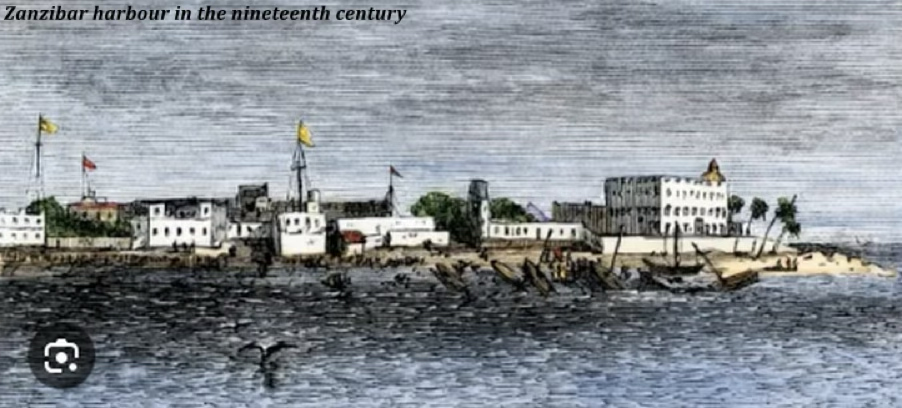
In the 1870s The Sultan of Zanzibar, Seyyid Bhargash, was well disposed towards Westerners, particularly if their activities boosted the island’s commerce. The British India Steam Navigation Company (BISN) started a regular service of steamers between Bombay and Aden to Zanzibar and Portuguese East Africa. They needed an agent in Zanzibar to service this and appointed Captain H. A. Fraser to the post. Unfortunately Fraser died two years later and for a while the business was carried on by his assistant Archibald Smith. In 1875 Edmond Mackenzie from the staff of Messrs McKinnon, Mackenzie and Company of Calcutta arrived in Zanzibar. Soon Smith and Mackenzie organized a joint trading arrangement. A year later Archibald Brown came to the Zanzibar and joined the others in their new trading venture Trade on the East African coast was expanding and European powers were becoming interested in the region So it was decided to establish a new firm to take over the conduct of the Zanzibar Agency and Smith Mackenzie and Company was duly launched with as partners Archibald Smith, Edmund Mackenzie and Archibald Brown. It acted as agent for BISN in Zanzibar.
What did the new firm deal in? Its ledgers provide interesting examples of its activities. In 1879 indents sent to London for trade goods comprised inter alia fish hooks, 3000 Tower muskets, 200 Navy pistols, a secondhand safe, 10 casks of cement, 30 copies of the Quran, and 30 cases of dates from Basra. The company regularly bought rubber and ivory and from 1881 they dealt in cloves then flourishing in Zanzibar. The firm also had a maritime character because it provided the fresh water for vessels anchoring in the harbour. This was done with a small fleet of craft, at first consisting of one small steam launch and five wooden boats containing 400-gallon water casks. The water came from 8 miles to the north of the town of Zanzibar where the water boats were filled by hand with fresh water on the beach at low water. They were refloated at high tide for the return journey to the harbour. Two years after the establishment of the company the firm extended its operation to Portuguese Africa (Mozambique).
The firm kitted out Henry Morton Stanley’s Emin Pasha Relief Expedition in 1886 and provided it with 620 Zanzibar porters. William Mackinnon, chairman of BISN, having noted the success of the Zanzibar firm, established the Imperial British East Africa Company in 1888, with Smith, Mackenzie and Co holding £5000 of its shares. J.W. Buchanan was sent to Mombasa as the agent of Smith, Mackenzie and as the administrator of IBEA. William James White Nicol had been sent out to Zanzibar in 1887 to replace the deceased agents – in fact, he travelled there on the same ship as Stanley and thereafter undertook the task of receiving, copying and transmitting Stanley’s dispatches when they arrived from the interior. He was in Bagamoyo to meet the expedition when it returned to the coast with Emin Pasha and was one of the 34 people at the fateful dinner in Bagamoyo in December 1899, when Emin Pasha had his much-discussed accident. Emin was half blind and fell 14 feet from a first storey balcony to the street below. He was unconscious until early the next day with a bad fracture to the base of his skull and then he died.
Edmund Mackenzie died of malaria in 1887 and in 1892 Archibald Smith died in Zanzibar. The trio of pioneers was extinguished when Archibald Brown was killed by a shark in Mozambique harbour, also in 1892. But Nicol was admirably suited to maintain the firm’s position in Zanzibar and the East African Coast. His endeavours will be the subject of the next blog.
https://www.europeansineastafrica.co.uk
Recent Comments