
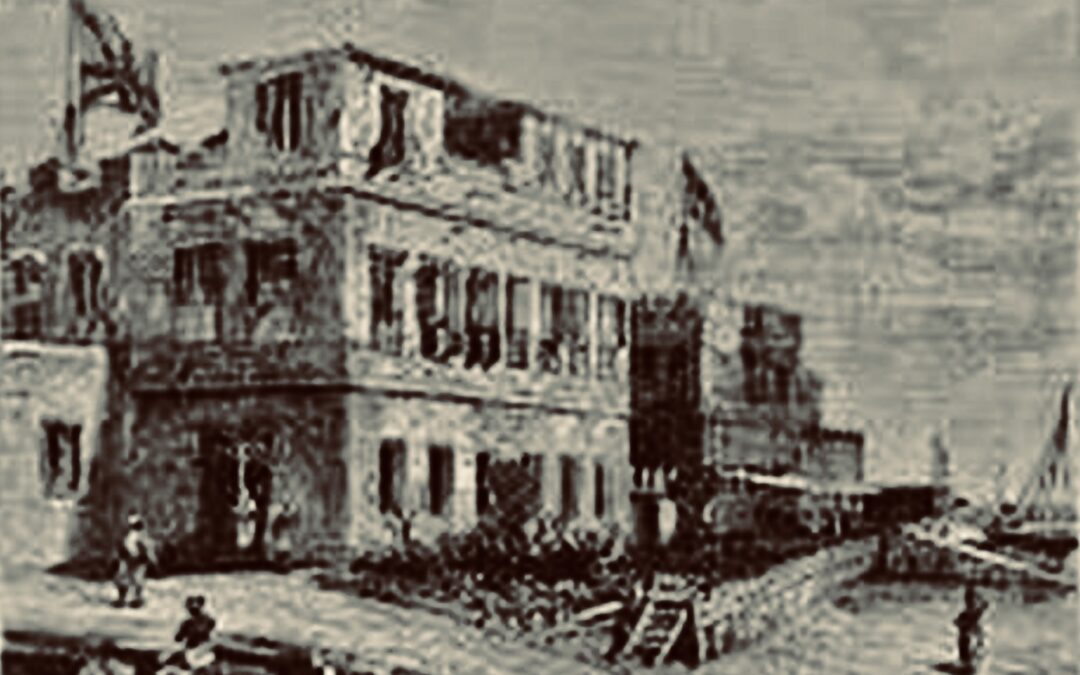
As part of their attempts to counter the Slave Trade, the British sent Atkins Hamerton to Zanzibar in 1842 to discover the extent of the trade in human beings. He was lent a house by Seyyid Said, the Sultan of Zanzibar, on the foreshore near the Sultan’s palace. It was unfinished, was in the sea at spring tides, and its beams and rafters were decaying from the constant damp. The outside needed plastering and 16 large windows were needed. All this was done and Hamerton, now appointed British agent, and later consul, was more comfortably housed. British expeditions to the interior of Africa used Zanzibar as the jumping off point, so the consulate was most useful. Richard Burton, planning an explorative mission in 1856, described the British consulate as “a large, solid pile, coloured like a twelfth-cake, and shaped like a claret-chest, which lay on its side, comfortably splashed by the sea.” It was a constant scene of activity, a meeting place for all nationalities welcomed by Hamerton’s Irish bonhomie.
On the death of Hamerton in 1857 every room and box in the consulate was immediately sealed on the Sultan’s orders. A subsequent consul, Captain Playfair, maintained in 1861 that the consulate building required considerable repairs and alterations to make it habitable for a family as on no previous occasion had the British agent been married. It was discovered that the building, given rent free to the British by the Sultan, was in fact rented by the Sultan from a cousin. Playfair said the consulate should be purchased or at least rented. There were two wings used as outhouses and stables for which the Sultan had been paying $80 and $60 per annum. The right wing could not be purchased for a reasonable sum and was therefore abandoned. The left wing was bought for 1,400 Maria Teresa dollars and a small piece of ground next to it for 200 Maria Teresa dollars, and these together served as outhouses and stables. The centre portion was not acquired till 1867.
In 1866 David Livingstone arrived and was given a room at the top of the consulate. He was not impressed: “2nd March 1966. The stench arising from a mile and a half or two square miles of exposed sea beach, which is the general depository of the filth of the town, is quite horrible. At night it is so gross or crass one might cut out a slice and manure a garden with it; it might be called Stinkibar rather than Zanzibar. No one can long enjoy good health here.” At least Hamerton had prevailed upon the Sultan to forbid the practice of leaving the bodies of dead slaves upon the beach for dogs to tear to pieces.
Six years later a package four-and-a-half feet long was brought to the consulate. The surgeon who examined it said: “It was encased in bark, wrapped in cloth and covered with a rug. The head and neck only were exposed. The colour was very dark, the face was much decomposed and the features were not recognizable. There were white hairs on the cheeks, chin and upper lips, and also on the head. The hair was straight like that of a European. From the peculiar formation of the skull I concluded that the body was that of Dr Livingstone.” Livingstone’s body was then taken to London and buried in Westminster Abbey.
The consulate suffered during the ‘Great Hurricane’ of 14 April 1872. Consul Kirk tells us what happened: “The storm…increased to a gale [which] increased to hurricane force. For the rest of the day it raged with unabated fury. Of the shipping in the port only the Abydos remained afloat. The narrow streets of the town became impossible torrents. Houses were blown down, native huts were swept away and most of the clove and coconut plantations were levelled to the ground. The first gust drove in the windows of the Agency [consulate] and of my quarters which stand a little back, broke open doors and threw tables and couches in confusion against the opposite walls. As the sea rose sheets of salt spray and rain drifted in at the broken windows and filled the rooms a foot deep with water. The sea was driven with such forces to undermine and sweep away the whole embankment of stone and double row of wooden piles that protect the foundations of the English, German, and American consulates, and throw down an immense wall four feet thick with foundation eight feet deep in front of the garden, which was in great part washed away. The consulate boathouse and two boats have been entirely destroyed. During the height of the gale the consular office was burst open by the wind, and a teak chest, in which many valuable documents were preserved, and all pigeon holes in which matters of current business were deposited were gutted of their contents. I recovered in the street many government orders and confidential memoranda, but other documents of importance are utterly lost. In my own quarters, which are behind the consulate, windows were burst open and carried away, while the floor of the drawing room was covered a foot deep with water in which books, pictures, and china, with tables, chairs etc formed a confused and sodden heap.”
The year 1873 brought changes. Because sterner measures and more staff were required for the suppression of the Slave Trade, a larger building was required for the British consulate. A property on Shangani Point known as Mambo Msiige was acquired for the consul, and in 1874 the old consulate fell from its high estate to the to be the residence of one of the consul’s assistants. In 1890 it was sold, for £4,000, to the trading company Smith Mackenzie. The company sold it for government offices in the 1970s. The whitewashed building still stands, displaying a circular plaque stating that: “Here at different times lived Speke, Burton, Grant and Kirk. David Livingstone stayed here and in this house his body rested on its long journey home.”
Recent Comments