
Firmly established in Zanzibar, the firm Smith Mackenzie was in an excellent position to take advantage of the opportunities for trade on the mainland once the Imperial British East Africa Company penetrated the interior of the lands that were to become Kenya and Uganda. They had an office in Mombasa and began to fit out the caravans trekking into the interior, for walking was the sole means of locomotion to the small stations on the route to Uganda. At first dispatching caravans on behalf of other traders, missionaries and administrators, in 1893/4 Smith Mackenzie sent out three caravans of their own to Uganda. These caravans were huge and lucrative.
In 1894 the company embarked on a joint venture with Andrew Dick who had been trading in the country for a while. Disaster met this expedition when in November 1895, in a fight with the Maasai in the Kedong Valley, Dick’s caravan was massacred and he was speared through the heart. By 1896 Smith Mackenzie had a store at Mumias and they decided it would be opportune to set up a trading post near that of IBEA’s administrator Francis Hall, at Fort Smith, a few miles from what was to become Nairobi.
On 11 March 1896 Walter Trefusis, Smith Mackenzie’s agent, arrived at Fort Smith and fixed on a piece of land off the road below Kinanjui’s village, as a place to erect a store. It was to be run by John and Mary Walsh. There were few Europeans around but Trefusis participated in the limited social life, as Francis Hall described in a letter to his father of 8 October 1896: ‘Martin and his wife came up and stayed here about 12 days. I gave them my quarters and we had a very jolly time. She is Portuguese but very nice; and plays, and sings in several languages, and as old Dugmore (in charge of the troops) has the American organ (that I brought out for him) up here, we had some musical evenings, Russell on the 1st whistle, Lane banjo and Mrs M. on the organ, while I occasionally had to warble as my share, and another fellow here, Trefusis, plays the autoharp very well. By-the-bye I shall be mentioning names you don’t know, so I must tell you that two Mombasa firms have agents up here, living about 1000 yards from the Fort. Trefusis, a very good sort who has travelled the world, is one, and a man named Walsh with his wife for the other.’
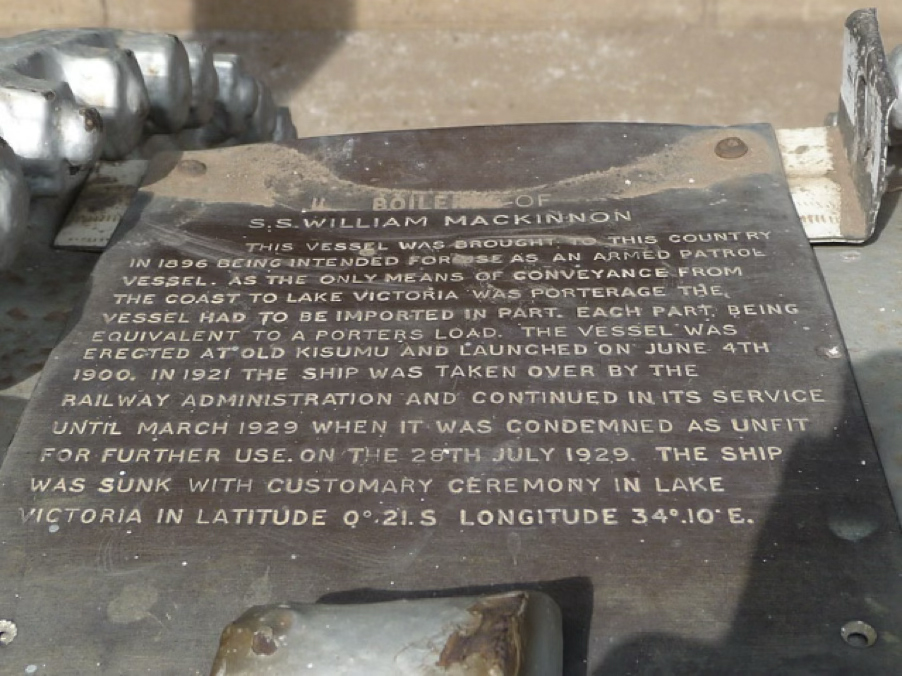
One of Trefusis’ tasks was to oversee and care for the parts of the 70-ton, single-screw steamer, the SS William Mackinnon, ordered by William Mackinnon, chairman of the BI Steamship Company. The ship was to ply Lake Victoria, 600 miles from the coast. It would have to be carried there in parts, for assembly on the lake’s shore. Built in Glasgow, the ship was disassembled into 3,000 parts and packages, none of them exceeding 60 lbs, which was all a man could carry. Some of the packages were too much for porters and were abandoned along the way of the route to the lake. Pack animals were tried, but died of rinderpest. Gradually all the parts found their way to Lake Victoria, the ship was built, and launch took place on 4 June 1900.
The year 1896 also saw the establishment of a branch of Smith Mackenzie in Uganda. This branch was charged with no less than 2,300 loads of goods dispatched in five caravans. However, the enterprise was doomed to failure because the Uganda mutiny in 1897 caused the firm to withdraw from this sort of business. They turned their attention to petroleum products, chiefly kerosene, and during 1898/9 the firm was appointed agents for M. Samuel & Co. and the Shell company of East Africa. This involved the construction of tanks for bulk supplies. The firm also acquired in 1907 the cutting rights of mangrove bark in the Lamu district, requiring a branch of the firm to be established on the island of Lamu. Smith Mackenzie also had interests in the area known as Nyali on the mainland coast just north of Mombasa Island, where sisal was planted.
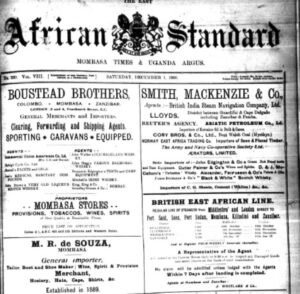
In the first decade of the twentieth century Smith Mackenzie exported locally produced exports including clothes, chillies, coconuts, copper and ivory. They represented the Union Steam Navigation Company, Lloyds, Reuters and several British insurance companies. They continued to meet the expeditionary and military needs of the East Africa Protectorate and were further responsible for supplying coal to British and German naval vessels. Between 1916 and 1923 new offices were opened in Nairobi, Kisumu, Kampala, Dar es Salaam, Tanga and Lindi. Smith Mackenzie was well on its way to becoming the prime commercial enterprise in East Africa.
Recent Comments